Ask a room of Malaysian parents whether their child should learn AI, and almost everyone nods. Ask what that means in practice, and the room goes quiet.
That gap is fair. AI moved from a research topic to an everyday tool faster than most school curricula could respond. Parents are left with a real question and very little guidance: is this something my child needs, when should they start, and what does "learning AI" actually look like for a ten-year-old?
This guide answers those questions plainly — no hype, no jargon.
What "AI literacy" actually means for a child
AI literacy is not about a child building the next ChatGPT. It's about four capabilities, and each one is teachable at a surprisingly young age:
1. Understanding what AI is — and isn't. A child who understands that AI learns from data, and that data can be incomplete or biased, treats its output very differently from a child who thinks the computer "just knows things." This is the single most important lesson, and it's the one most often skipped.
2. Using AI tools well. Prompting, checking output, knowing when a tool is the wrong choice. This is a genuine skill with a learning curve — the same way research skills were a learning curve for the generation before.
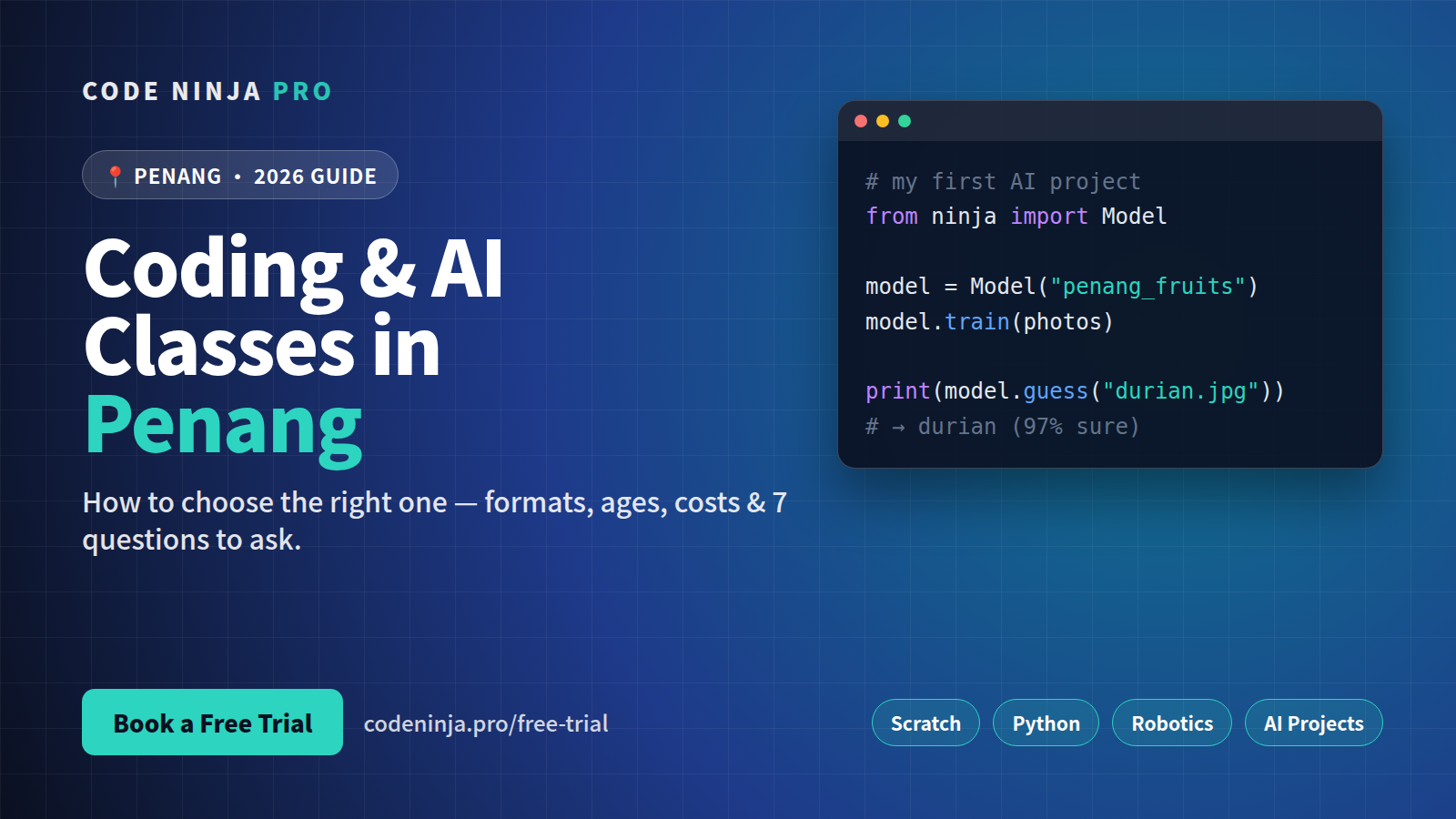
3. Building with AI. Training a simple image classifier. Making a chatbot that answers questions about a topic they love. Programming a robot to follow a line. The moment a child trains a model themselves, AI stops being magic and becomes a system they understand.
4. Judging AI responsibly. When is it fair to use an AI tool for homework? What happens when a model gets something confidently wrong? These conversations build judgement that will matter far more at eighteen than at eight.
Notice that only one of the four requires heavy coding. AI literacy is broader than programming — but programming is what turns understanding into capability.
Why this matters now, specifically in Malaysia
Malaysia's push toward a digital economy has been steady and well-documented, and demand for technology skills has followed it. But the more immediate argument is simpler than national policy.
Your child is already using AI. It's in the search results they read, the apps they use, the video feeds they scroll, and increasingly the homework help they reach for. The question was never whether they'd encounter AI — it's whether they'd encounter it as an informed user or a passive one.
There's also a timing advantage. Right now, a Malaysian student who can build and explain a working AI project stands out sharply — in scholarship interviews, in competitions, in university applications. That advantage narrows every year as these skills become standard. Starting early is worth more today than it will be in five years.
The right age to start (and what's realistic at each stage)
There's no single correct age, but there is a sensible progression. What matters is matching the activity to the stage of thinking a child is actually at.
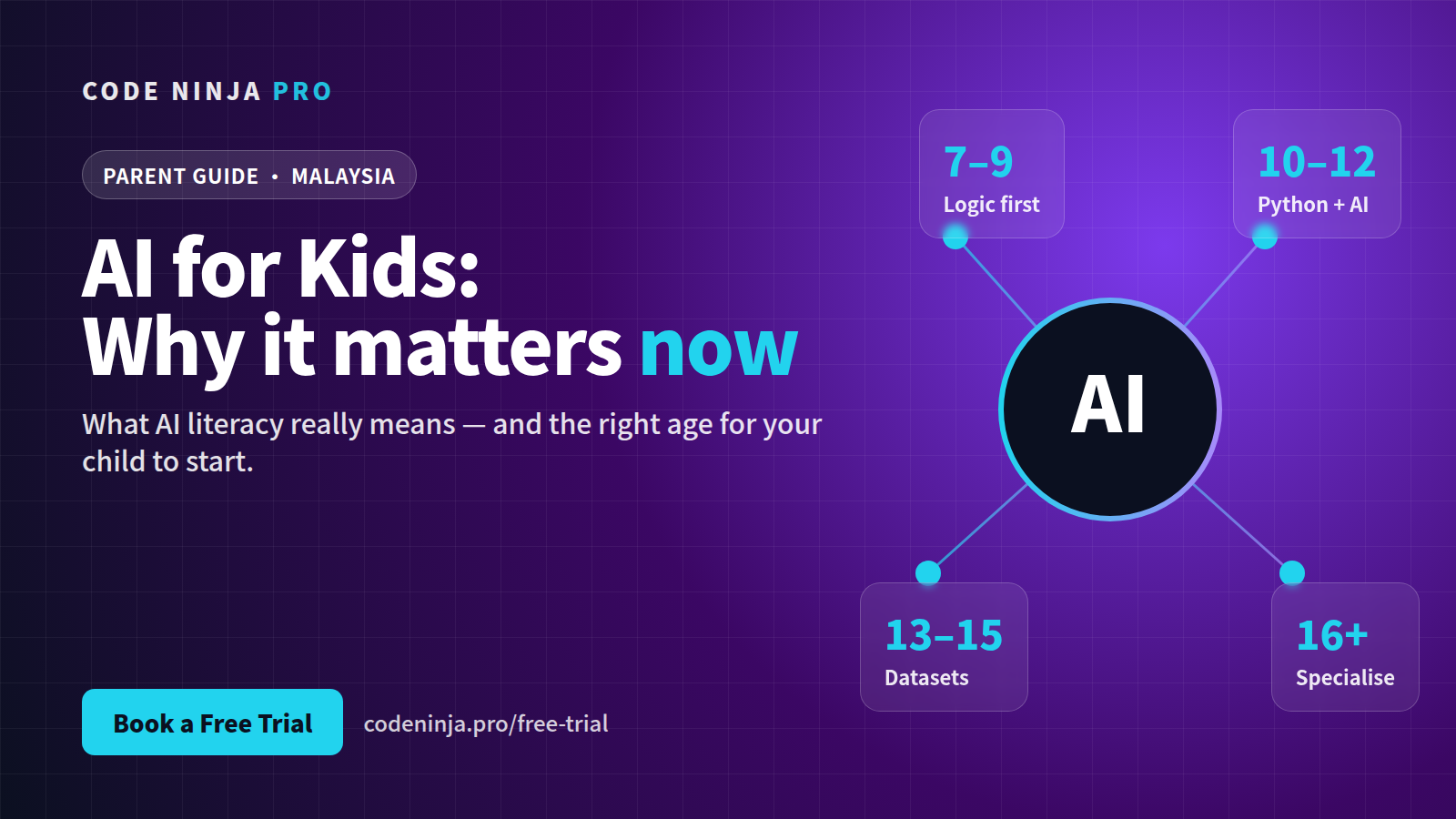
Ages 7–9: Logic before syntax
At this stage, children learn best by manipulating things they can see. Block-based programming (Scratch and similar) teaches sequencing, loops, and conditionals — the real foundations — without the frustration of typing syntax correctly.
AI enters as pattern recognition: teach the computer to tell cats from dogs by showing it examples. Children grasp this intuitively because it mirrors how they learn.
What success looks like: your child can explain, in their own words, why the computer got something wrong.
Ages 10–12: The bridge years
This is the sweet spot. Children in this range have enough abstract reasoning for real programming, and enough curiosity to push past the first hard part.
Text-based coding begins, usually with Python. AI projects become genuinely buildable — a model trained on their own photographs, a simple recommendation system, a chatbot with a personality they designed. Maths starts reinforcing the work rather than blocking it: coordinates, percentages, averages, and basic probability all show up naturally.
What success looks like: your child finishes a project nobody assigned them.
Ages 13–15: Depth and independence
Now the fundamentals can carry real weight. Students work with datasets, understand training and testing, meet the idea of accuracy and error, and start seeing where a model's limits come from.
This is also when competition and portfolio work becomes worthwhile — hackathons, robotics, olympiad-adjacent problem solving. Projects can start solving problems the student actually cares about.
What success looks like: your child can defend their design choices to someone who disagrees.
Ages 16+: Toward specialisation
Computer vision, natural language, automation, data engineering. At this stage the goal shifts from exposure to depth, and the work should look like something a first-year university student would recognise.
A note on starting late: a fifteen-year-old beginning from zero is not behind. Older students move through the foundations dramatically faster than younger ones — often covering two years of primary-level content in a few months. The best time to start is simply now.
Five questions to ask any AI or coding programme
The market has filled quickly, and quality varies. These five questions separate substance from marketing:
- What will my child have built after three months? A real answer names projects. A vague answer names topics.
- Do students write their own code, or fill in blanks? Template-completion feels productive and teaches very little.
- How large are the classes? Programming needs individual debugging time. Beyond eight to ten students, that stops happening.
- Who teaches — and have they built anything themselves? There's a meaningful difference between someone delivering a script and someone who has shipped working systems.
- How is progress shown to parents? You should see work, not just attendance.
What this looks like at Code Ninja Pro
We built our programme around one conviction: children learn technology by building things that work, not by memorising definitions.
Students progress from visual programming through Python into applied AI — training models, working with computer vision, programming robots, and building projects they choose themselves. Classes stay small so every student gets debugging time with an instructor. Our maths-integrated track connects the problem-solving in code directly to the reasoning students need in school.
Most importantly, every student leaves with work they can show and explain.
Start with one class
The fastest way to know whether this fits your child is to let them try. Our free trial class is a real session — your child builds something in it, and you'll see how they respond to the work.
No obligation, no sales pressure. Just an honest look at whether this is right for your child.
Ready To Experience Coding First-Hand?
Join our FREE Trial Classes and discover the exciting world of coding, AI and robotics.