Penang has quietly become one of the better places in Malaysia to raise a technically curious child. The island's electronics and semiconductor corridor means technology isn't an abstract career here — it's what a lot of parents actually do for a living, and what a lot of students will go on to do.
That's produced real demand for coding and AI classes, and a correspondingly crowded market. This guide is written to help you navigate it: what the different class formats actually offer, what suits which age, what you should expect to pay, and the questions worth asking before you commit.
The types of classes you'll find in Penang
Most programmes fall into one of four categories. They're not interchangeable.
Block-based coding (Scratch and similar)
Drag-and-drop programming for younger children, typically ages 7 to 10. Good programmes use it to build genuine logical thinking — sequencing, loops, conditionals — rather than as a game-making novelty.
Watch for: classes where children mostly customise pre-built games. That's assembly, not programming.
Text-based programming (usually Python)
The real transition, generally from age 10 upward. Python is the right first language for most students: readable syntax, and it happens to be the dominant language in AI work, so the skills carry directly forward.
Watch for: whether students type their own code or fill gaps in a provided template.
Robotics and hardware
Physical builds with sensors and motors. Strong for engagement — the feedback loop is immediate and tangible — and it makes abstract concepts concrete.
Watch for: kit-following versus actual programming. If every student's robot is identical, the thinking was done for them.
AI and applied projects
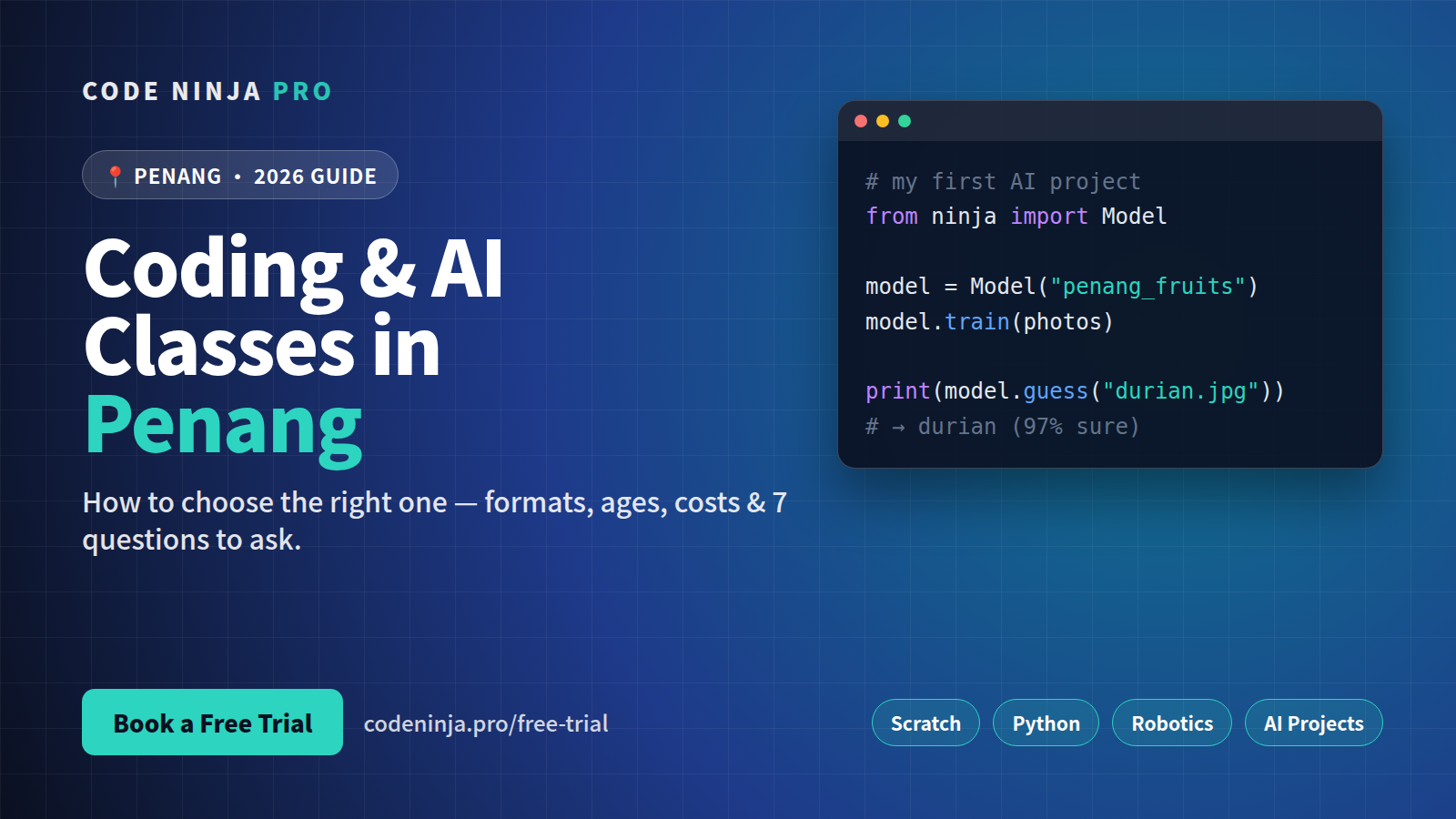
The newest category and the most inconsistent in quality. Done properly, students train models on their own data, work with computer vision or language tools, and learn why models fail. Done poorly, it's a demonstration students watch.
Watch for: a straight answer to "what will my child train or build?"
Matching the class to your child's age
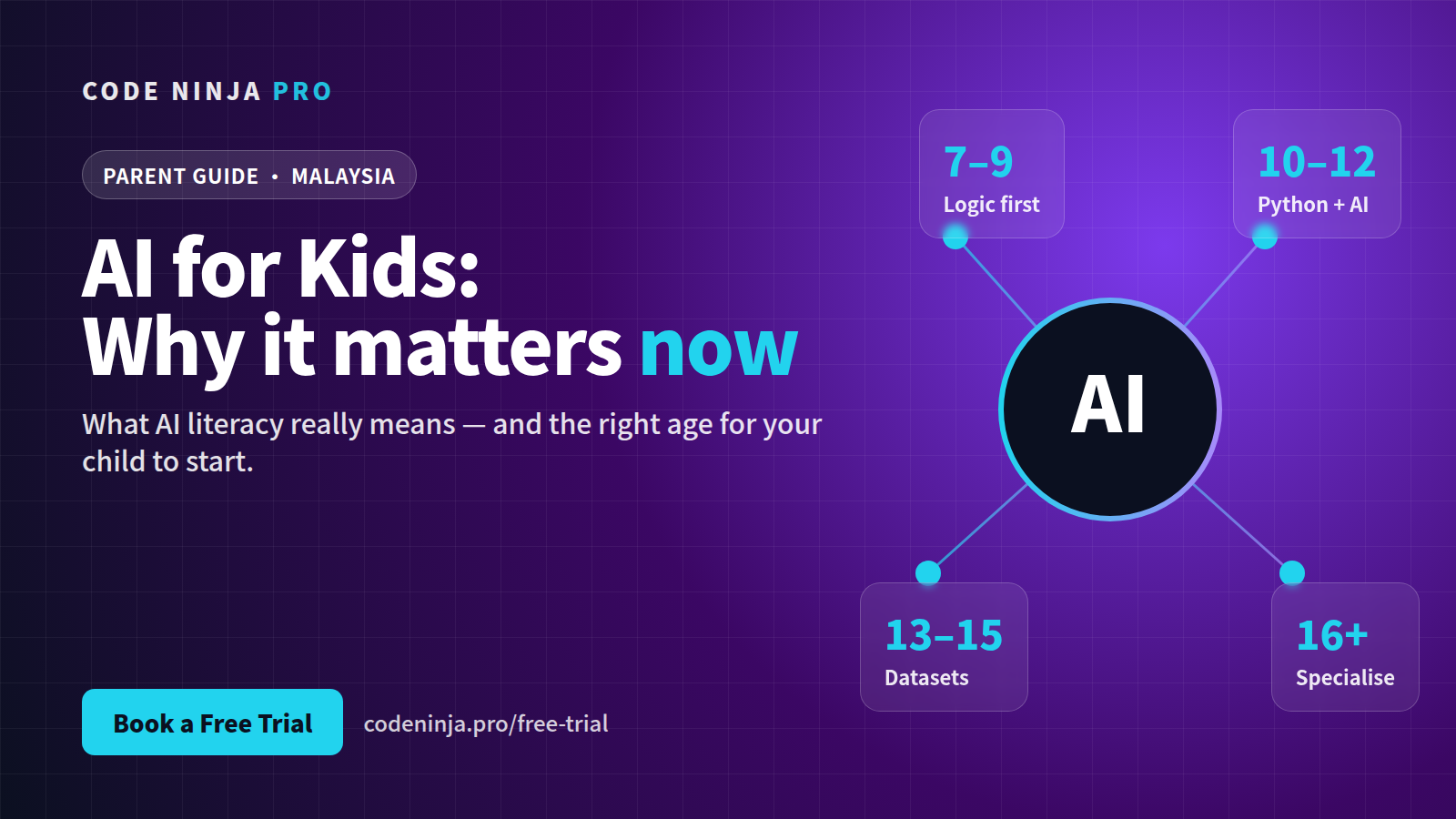
- Ages 7–9: Start with block-based coding. Most children this age are ready for simple AI pattern recognition.
- Ages 10–12: Start with Python basics. Most are ready for their first real AI projects and robotics.
- Ages 13–15: Start with applied programming. Most are ready for datasets, computer vision and competitions.
- Ages 16+: Move towards a specialisation. Most are ready for portfolio work, advanced AI and internship-level skills.
What coding and AI classes cost in Penang
Pricing varies widely, and the drivers are predictable:
- Class size is the biggest factor. Programming requires individual debugging time; a class of twenty cannot provide it, whatever the marketing says. Small-group instruction costs more for a reason.
- Instructor background. Practitioners who have built real systems cost more than script-readers, and it shows in what students produce.
- Equipment. Robotics and hardware tracks carry material costs.
- Format. Weekly term classes, intensive holiday bootcamps, and one-to-one sessions sit at different price points and serve different goals.
A useful reframe: the meaningful number isn't the monthly fee, it's the cost per project completed. A cheap class where your child builds nothing is expensive.
Seven questions to ask before enrolling
Bring these to any trial class or enquiry:
- How many students per instructor? Eight to ten is a practical ceiling for programming.
- What will my child have built after three months? Ask for specific project examples from current students.
- Do students write original code? Ask to see two students' work side by side. If they're identical, that tells you everything.
- Who teaches, and what have they built? Real-world experience changes how a teacher handles the moment a student's code breaks in an unexpected way.
- How do you handle different paces within one class? Every class has a range. The answer should be concrete.
- How will I see progress? Project work you can look at, not just attendance records.
- What happens if my child doesn't enjoy it? Confident programmes offer trials and reasonable exit terms.
Practical considerations for Penang parents
Location and traffic. Be realistic about the Penang Bridge and peak-hour traffic on the island. A brilliant class your family can't reliably reach becomes a missed class. Weigh a slightly closer option against a marginally better distant one.
Scheduling around tuition. Most Penang students already carry a full academic tuition load. Weekend sessions or holiday intensives often fit better than adding another weeknight.
Online versus in person. Online can work well for motivated older students. Younger children generally need someone physically present when the code doesn't run — that moment is where learning either happens or stops.
Continuity. Look for a programme with a clear path from beginner through to advanced work. Restarting elsewhere every year wastes momentum.
About Code Ninja Pro
We teach coding and AI to students in Penang, with a focus on building rather than watching.
How we work:
- Small classes, so every student gets time with an instructor when their code breaks
- A clear progression from block-based coding through Python to applied AI — no need to move elsewhere as your child advances
- Real projects, chosen by students where possible, so the work is theirs rather than a template
- Maths-integrated learning, connecting the reasoning in code to the reasoning students need in school
- Instructors who build, bringing working engineering experience into the classroom
Students train their own models, program robots, work with computer vision, and finish with projects they can demonstrate and explain.
Come and see a class
The honest way to judge any programme is to watch your child in one. Our free trial is a real session — your child builds something, and you'll see how they engage with it.
Book a free trial class in Penang →
No obligation. If it isn't the right fit, we'll say so.
Ready To Experience Coding First-Hand?
Join our FREE Trial Classes and discover the exciting world of coding, AI and robotics.