AI Arrives in Malaysian Classrooms in 2027: Is Your Child Ahead or Catching Up?
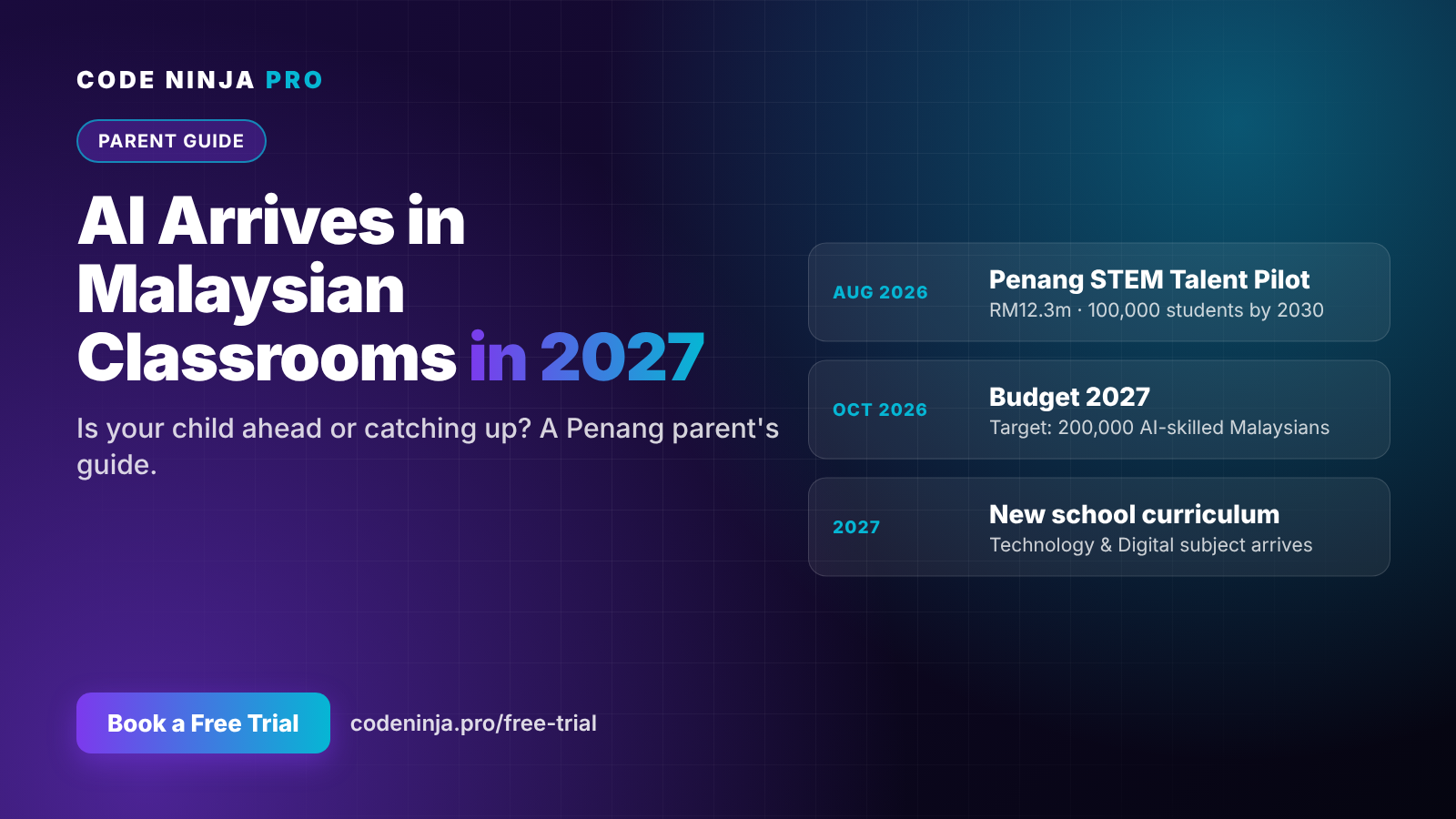
In 2027, something new appears on Malaysian school timetables. Under the Kurikulum Persekolahan 2027 (KP2027), pupils meet a subject called Technology and Digital, built to develop digital fluency through hands-on projects.
For some parents that's exciting. For others it raises a quiet worry: if AI and coding are now part of school, is my child already behind?
The honest answer is no — not yet. But the families who start a little early will find 2027 much easier. This guide explains what's changing, why Penang in particular should pay attention, and how to give your child a calm, practical head start.
What is actually changing in 2027?
KP2027 reorganises primary schooling into stages. According to the Ministry of Education's Curriculum Development Division, the new Technology and Digital subject is introduced at Tahap III of primary school (Year 5 and 6) and continues into lower secondary, using hands-on, project-based activities. The Ministry has also said Year 5 and 6 pupils will learn basic technical disciplines that include programming.
In plain terms: by the time your child is 11, coding and digital problem-solving stop being an "extra" and start being part of school.
Schools will teach the foundations. What a curriculum can't easily do is give every child enough time to build: to get stuck on a bug, fix it, and feel the click of understanding. That depth comes from practice, and practice takes hours.
Why this matters even more in Penang
Penang isn't just watching the AI wave. It's helping build the hardware underneath it. Our state is at the centre of Malaysia's electrical, electronics and semiconductor industry, and the government is now investing directly in the next generation of talent.
On 10 August 2026, the Economy Ministry launched a RM12.3 million STEM Talent Pilot in Penang, aiming to reach 100,000 students by 2030 with exposure to AI, data science, robotics and digital technologies. The Economy Minister also said Malaysia needs around 60,000 skilled engineers to move further up the semiconductor value chain.
Then came Budget 2027, tabled on 9 October, with a national target of 200,000 AI-skilled Malaysians and an extra 100,000 free subscriptions to AI apps such as ChatGPT.
Put those together and the direction is clear. The opportunities are being built right here, in our state. The question for parents is not whether AI skills will matter, but whether our children will be ready to take those opportunities when they arrive.
Head start vs. catching up: what the difference looks like
Two children start Year 5 in 2027.
The first has never written a line of code. Their first experience of programming is in a full classroom, sharing devices, on a fixed timetable. They'll learn, but it may feel like a new language spoken too fast.
The second has spent a year or two building small games in Scratch, then simple programs in Python. When the teacher says "loop" or "condition", they already know what it means because they've used it. They have room to be curious instead of anxious.
That second child isn't a genius. They simply met the ideas earlier, in a setting where mistakes were safe and progress was visible. That's what a head start really is: not pressure, but familiarity.
What a good early AI and coding path looks like
At Code Ninja Pro, we follow a sequence that matches how children actually learn:
- Scratch — logic, sequences and loops through games and stories. Ideal for younger beginners.
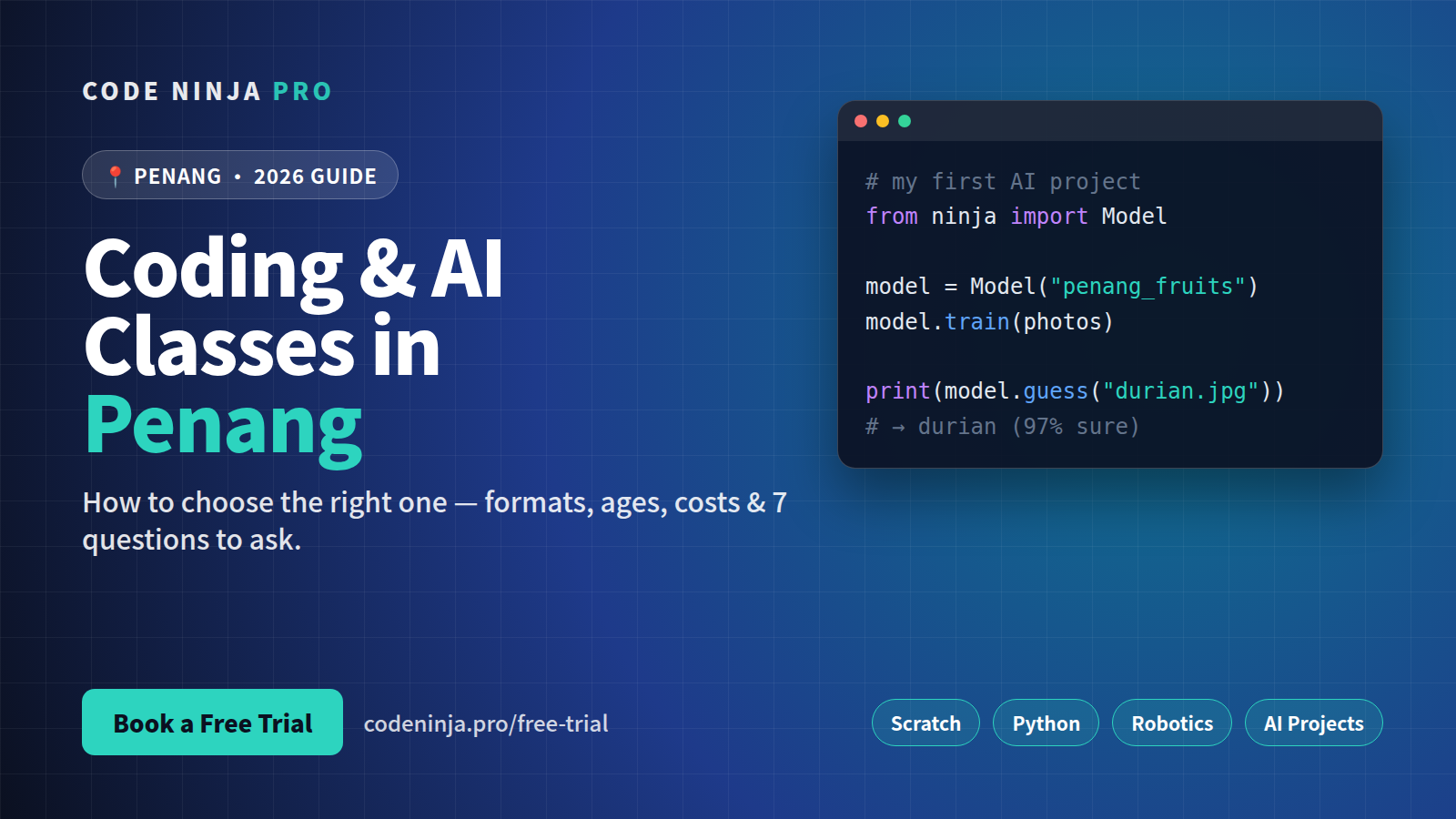
- Python — real code, typed by hand. Children build quizzes, maths games and their first simple AI projects.
- Web and app development — turning ideas into things other people can use.
- AI and robotics — training simple models, controlling hardware, and understanding how AI makes decisions.
The key word is build. Watching videos about AI doesn't teach a child how AI works. Training a tiny model, seeing it make a silly mistake, and fixing it does.
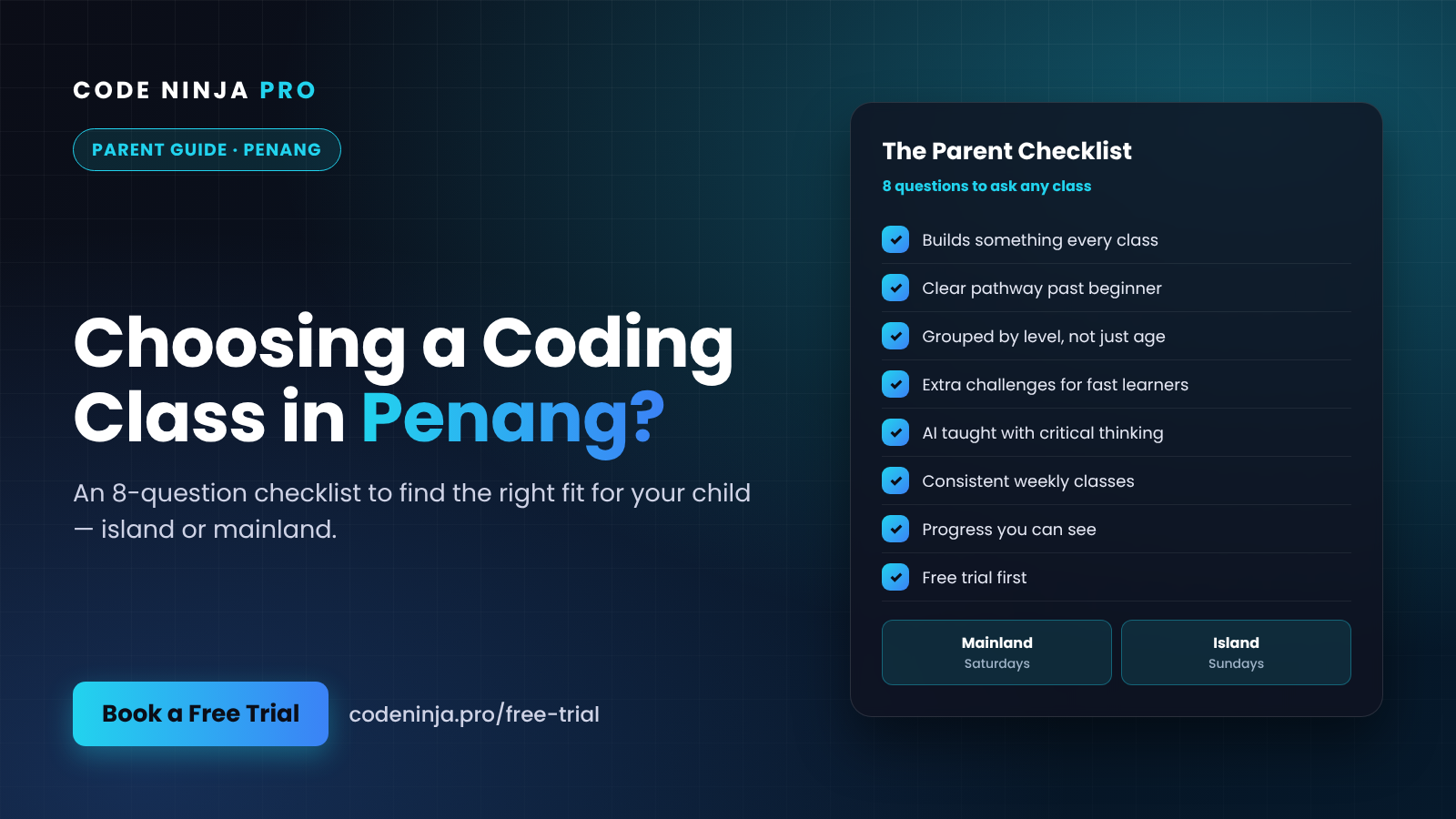
5 questions to ask before choosing a coding or AI class
Use this checklist for any class you're considering, including ours:
- Does my child build something real in the first few lessons? Look for projects, not just worksheets or videos.
- Is there a clear path? A good programme shows where your child goes after Scratch, after Python, and so on.
- How big are the groups? Coding needs a tutor who can sit beside a stuck student and ask the right question.
- Is AI taught as a tool to understand, not just a tool to use? Children should learn how AI learns, where it fails, and how to check its answers.
- Can I try before committing? A trial class tells you more than any brochure.
What children should learn about AI (beyond using it)
Free AI tools are becoming easy to access. That's good, but it also means simply using AI will soon be ordinary. The skills that set a child apart are deeper:
- Asking good questions. Clear instructions get better answers, from people and from machines.
- Checking the output. AI can be confidently wrong. Children should learn to test and question what it says.
- Understanding the basics of how AI learns. Data in, patterns found, predictions out — and why bad data gives bad results.
- Using AI responsibly. Privacy, honesty in schoolwork, and knowing when a human should decide.
These are thinking skills. Coding is simply one of the best ways to practise them, because a computer gives instant, honest feedback.
Is AI coming too early for young children?
It's a fair concern, and some parent groups raised it when AI in primary schools was first announced. Not every child needs AI lessons at seven. What most young children benefit from is the foundation underneath AI: logical thinking, breaking problems into steps, and the confidence to try, fail and try again. Scratch is perfect for that.
As children grow, those foundations make AI concepts feel natural rather than intimidating. Starting early doesn't mean rushing. It means building steadily.
The bottom line
2027 will change what Malaysian children learn in school, and Penang is investing heavily in the talent that our industries will need. Your child doesn't need to be a prodigy. They need a head start that's practical, playful and paced to them.
Book a free trial class at Code Ninja Pro — mainland on Saturdays, island on Sundays. Your child builds something real in their first session, and you'll see exactly where they fit. 👉 codeninja.pro/free-trial
FAQ
When does the new Technology and Digital subject start? It is part of the Kurikulum Persekolahan 2027 (KP2027). The subject is introduced at Tahap III of primary school (Year 5 and 6) and continues into lower secondary.
What age should my child start coding? Many children start Scratch around 7–9 and move to Python around 10–12. Readiness matters more than age, which is why our free trial includes a level check.
Does my child need to be good at maths? No. Coding often makes maths feel more useful, because children use numbers to make games and programs work. Our projects build maths confidence along the way.
Will learning AI make my child depend on AI? Not if it's taught well. We teach children how AI works, where it goes wrong, and how to check it — so they stay in charge of the thinking.
Where are Code Ninja Pro's classes? We run classes on Penang mainland (Saturdays) and Penang island (Sundays). Book a free trial at codeninja.pro/free-trial to choose your slot.
Ready To Experience Coding First-Hand?
Join our FREE Trial Classes and discover the exciting world of coding, AI and robotics.