Chatbot vs AI Agent: A Plain-English Guide for Parents and Professionals
"AI agents" is one of the phrases you hear everywhere right now: at work, in the news, and maybe from your teenager. But what actually is an AI agent, and how is it different from the chatbots most of us already use?
Here's the plain-English version, with examples, honest limits, and what both children and working adults should learn.
The one-line difference
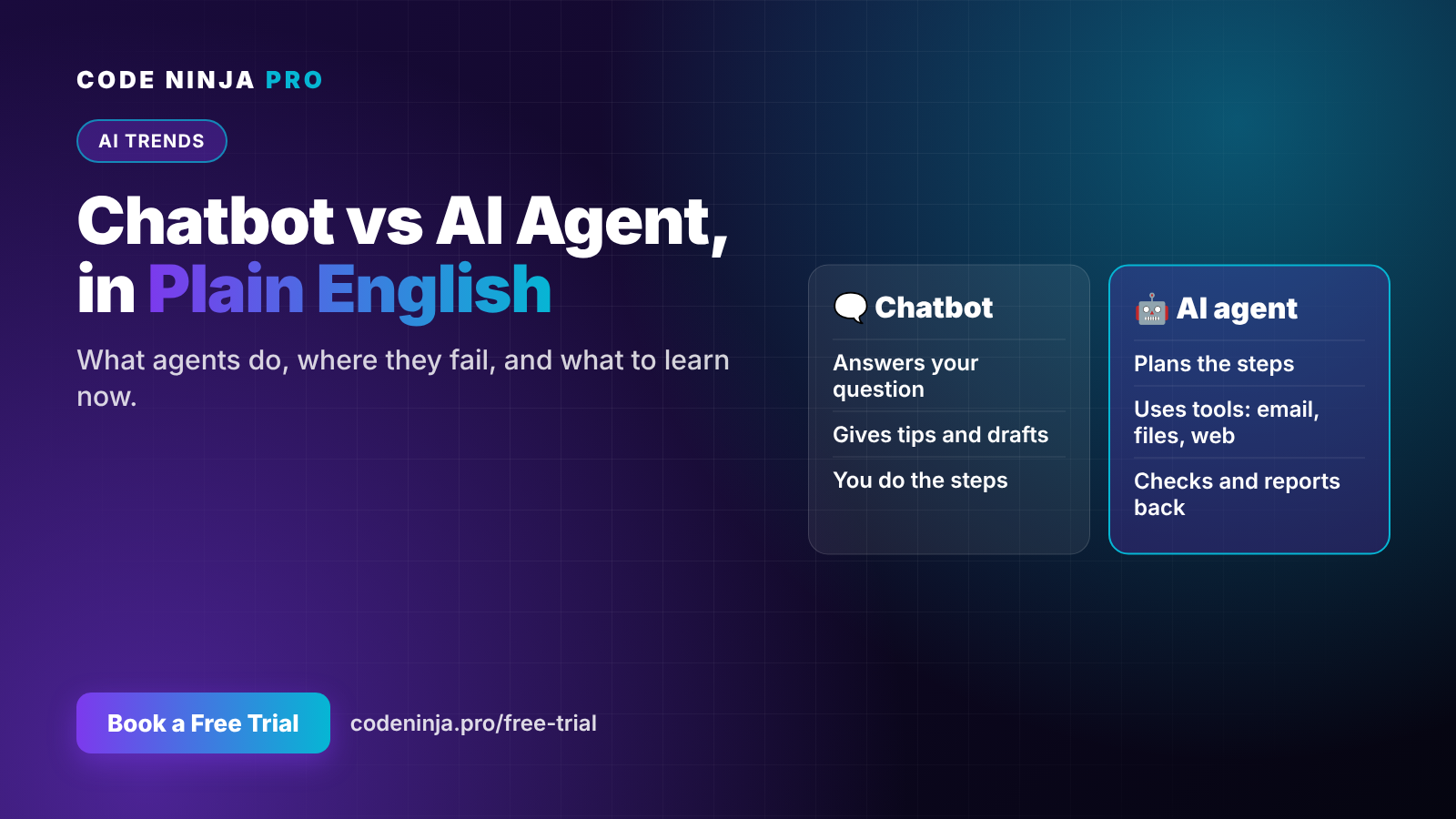
A chatbot answers. An agent acts.
IBM describes an AI agent as a system that autonomously performs tasks by designing workflows with available tools. In everyday terms: you give it a goal, and it works out the steps and carries them out.
How a chatbot works
You type a question. The chatbot writes a reply. If you want more, you ask again. You do the steps; the chatbot helps with each one.
That's already useful — for drafting, explaining, brainstorming and summarising. But the chatbot waits for you at every turn.
How an agent works
An agent follows a loop:
- Goal — you describe the outcome you want.
- Plan — it breaks the goal into smaller tasks.
- Act — it uses tools: searching the web, reading files, checking a calendar, filling in a spreadsheet.
- Check — it looks at the results and adjusts its plan if needed.
- Report — it hands back the finished result, ideally with a record of what it did.
The key ingredients are planning and tools. According to IBM, agents can break complex goals into subtasks and call tools to get up-to-date information, while simple chatbots without tools rely on continuous user input.
Side by side
What you give it
- Chatbot: A question
- AI Agent: A goal
What it does
- Chatbot: Writes a reply
- AI Agent: Plans and carries out steps
Tools
- Chatbot: Usually none
- AI Agent: Search, files, email, calendar, and apps
Your role
- Chatbot: Do each step yourself
- AI Agent: Define the task, approve, and check
Best for
- Chatbot: Drafting, explaining, and generating ideas
- AI Agent: Multi-step and repeatable tasks
Everyday examples
At home: "Find three weekend activities for a 9-year-old in Penang under RM50, check opening hours, and put them in a table." A chatbot gives suggestions; an agent can search, check and compile.
At work: "Every Monday, pull last week's sales from the spreadsheet, draft a summary for my manager, and save it to the reports folder." That's a repeatable workflow an agent can run with your approval.
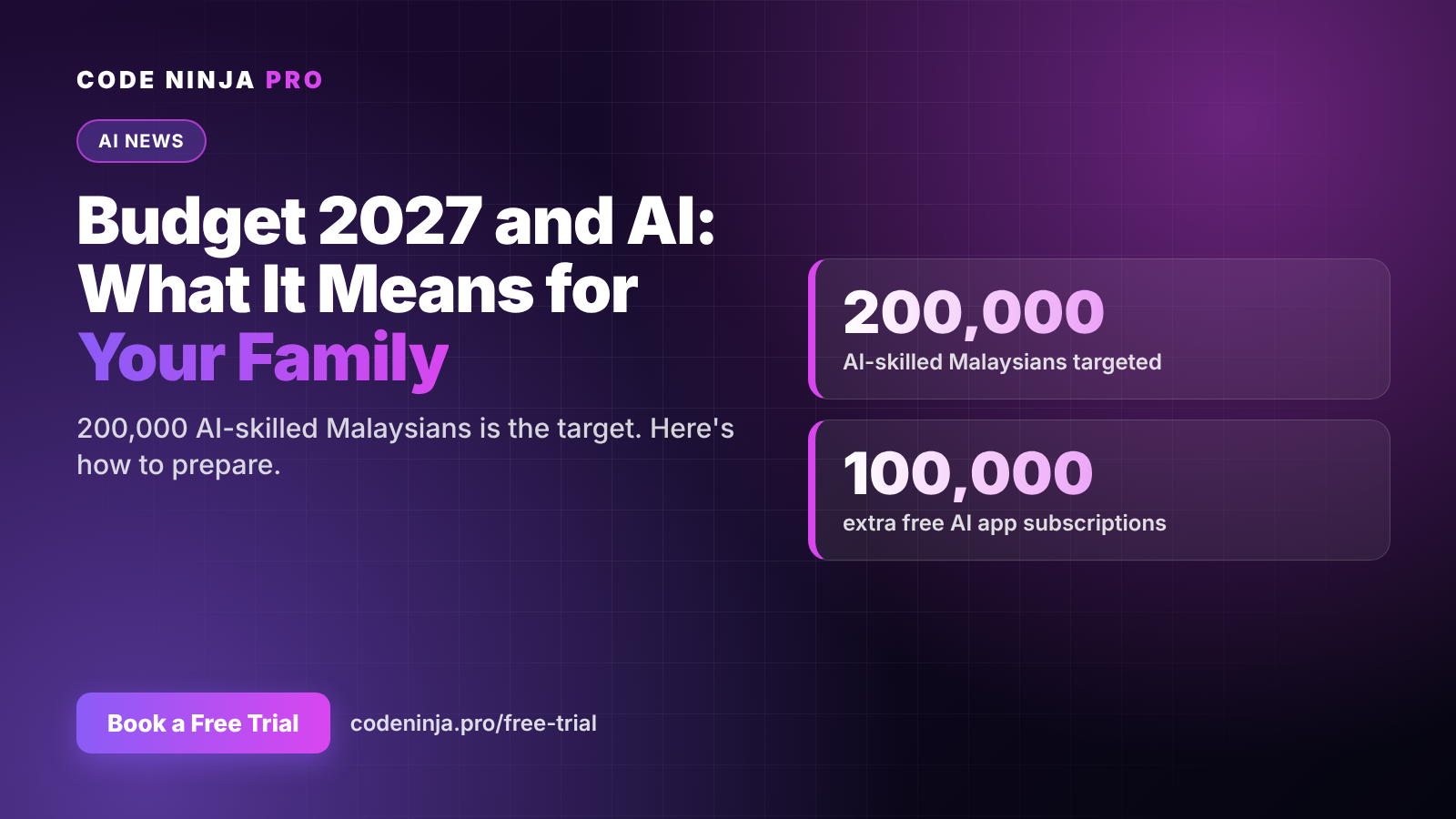
For small businesses: answering common customer questions, preparing quotes from a template, or tracking stock. Budget 2027 includes MDEC funding to help 4,000 micro, small and medium enterprises adopt AI and automate operations — agent-style workflows are a natural fit.
What agents can't do (yet) — and the risks
Agents are powerful, but they are not magic, and they're not a replacement for human judgement.
- They make mistakes. An agent can misread a page, pick the wrong file, or go round in circles. IBM notes agents can get stuck repeatedly calling the same tools.
- Access is risky. An agent connected to your email or files can do real damage if it misunderstands. Give it only the access it needs.
- Privacy matters. Poorly managed connections to business or personal systems raise security concerns.
- Humans must stay in charge. IBM recommends activity logs, the ability to stop an agent, and human approval for high-impact actions like sending mass emails or making payments.
The rule of thumb: let agents do the legwork; keep the decisions.
What children should learn
Children don't need to build agents to benefit. They need the thinking underneath:
- Breaking problems into steps — the same skill as planning in an agent. Coding teaches this directly.
- Understanding how AI makes decisions — and why it can be wrong.
- Checking results — never trusting an answer just because a computer gave it.
These are exactly what children practise when they code a game, train a tiny AI model, or debug a program.
What working adults should learn
For professionals, agents are most useful when you already know how to:
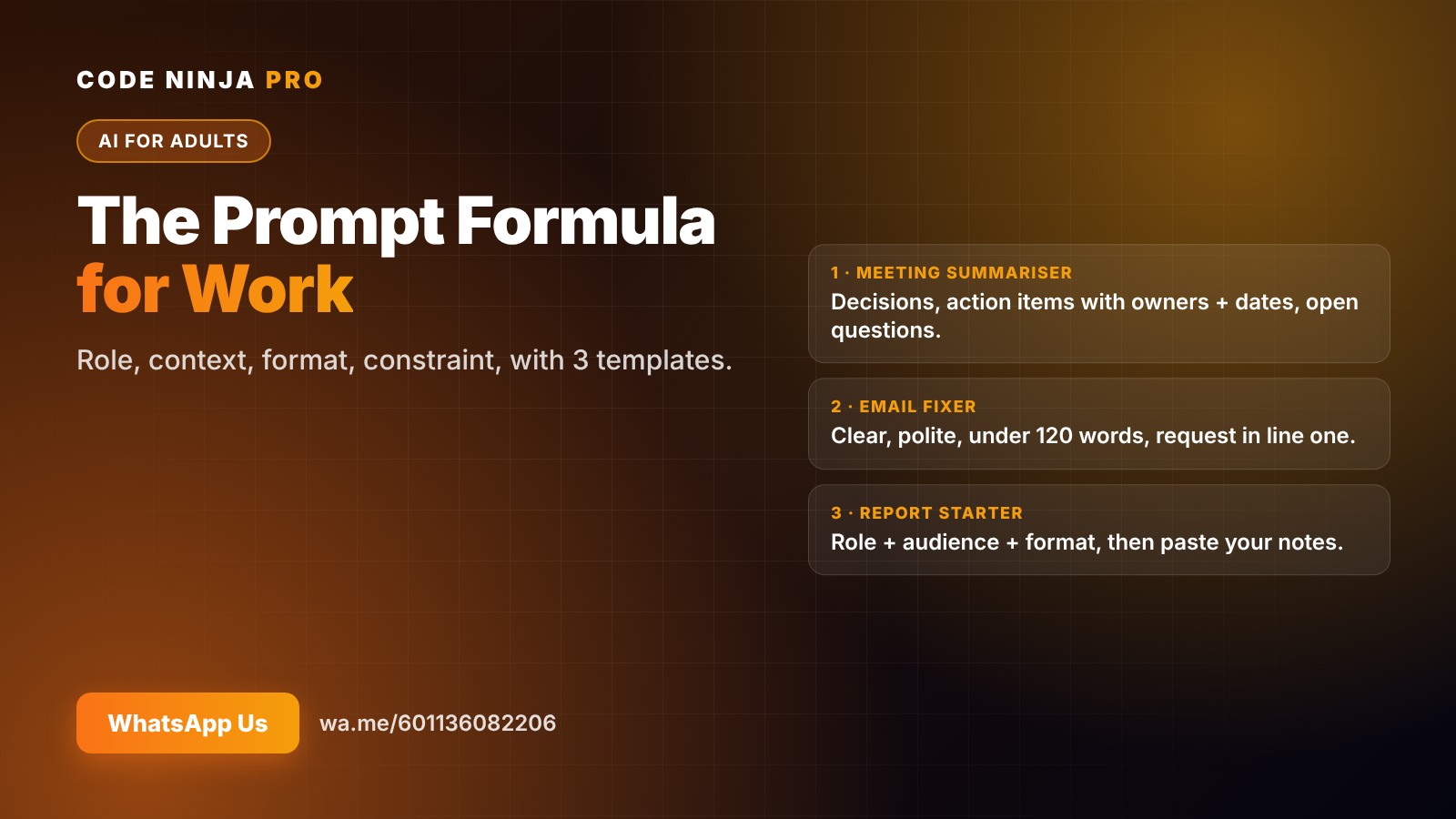
- Write clear, specific instructions (a good agent task is a very good prompt).
- Identify repeatable tasks worth automating.
- Review outputs critically before they go anywhere important.
- Set safe limits on what the agent can access and do.
How Code Ninja Pro can help
For children: our path runs from Scratch to Python to real AI and robotics projects, building the step-by-step thinking that agents rely on. Classes on Penang mainland (Saturdays) and island (Sundays). 👉 codeninja.pro/free-trial
For working adults: AI Productivity Pro & AI Agents is a 12-week online course, two 1-hour classes a week, that takes you from better prompts to building your own simple agents. 👉 WhatsApp us for details
FAQ
Is ChatGPT a chatbot or an agent? It depends on how it's used. Answering questions is chatbot behaviour; when an AI tool plans steps and uses tools to complete a task, it is acting as an agent.
Are AI agents safe to use? They can be, with limits: give minimum access, review their work, and require approval for important actions.
Will AI agents replace jobs? Agents change how tasks are done, but people are still needed to set goals, judge quality and make decisions. Learning to work with agents is the practical response.
Do I need to code to build an agent? Not always. Many tools now let you build simple agents with little or no code, though coding helps for more advanced ones.
Should children learn about AI agents? They should learn the foundations — step-by-step thinking, how AI works and checking results. Those make every future AI tool easier to understand.
Ready To Experience Coding First-Hand?
Join our FREE Trial Classes and discover the exciting world of coding, AI and robotics.