
Penang Makes the Chips That Power AI. Will Our Kids Design Them?
The phone in your hand, the laptop your child uses for homework, the servers that run AI chatbots — there's a good chance some part of them passed through Penang. For decades, our state has been one of the world's important centres for assembling and testing computer chips.
Now the ambition is bigger: not just making chips here, but designing them here. And that changes what our children should be learning.
Penang's next chapter: from making to designing
The semiconductor industry has two broad halves. "Back-end" work assembles, packages and tests chips. "Front-end" work designs them and builds the circuits on silicon wafers. Front-end work is generally higher-value, and it depends on engineers, designers and software talent.
Malaysia wants to move up that ladder. Speaking in George Town in August, Economy Minister Akmal Nasrullah Mohd Nasir said Malaysia needs around 60,000 skilled engineers to move further up the semiconductor value chain, from back-end towards front-end activities. He also noted that 86% of employers expect AI and information-processing technologies to change how their businesses operate.
The RM12.3 million bet on Penang's students
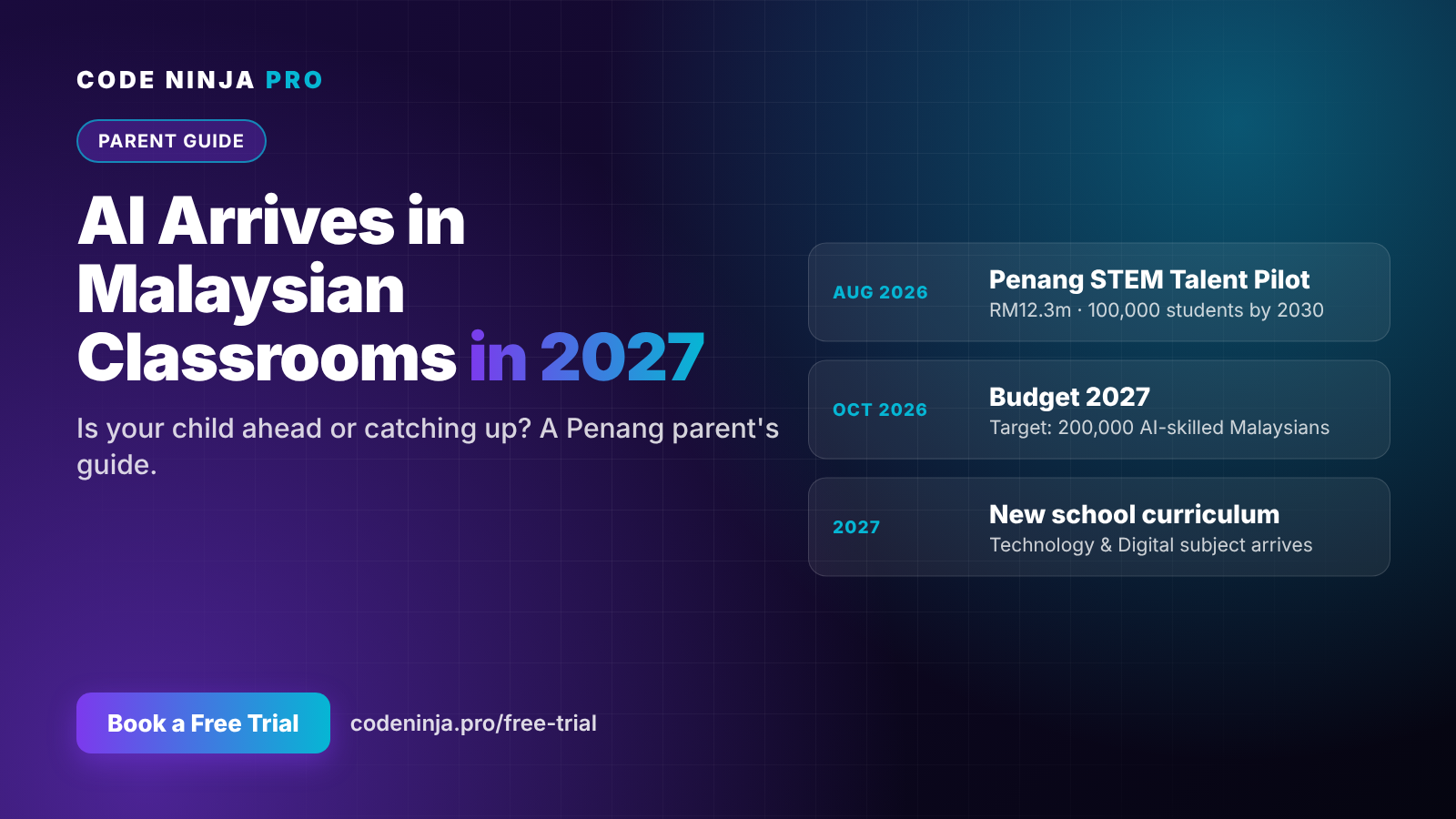
On 10 August 2026, the Economy Ministry launched a STEM Talent Pilot Project in Penang, with RM12.3 million allocated over four years. Its target: reach 100,000 students by 2030, building practical, hands-on skills in AI, data science, robotics and digital technologies.
The pilot builds on the Penang STEM Talent Blueprint, introduced by the state government in 2024. Penang was chosen because of its strong electrical and electronics, semiconductor and high-tech manufacturing base.
For Penang parents, the message is unusually direct: the government expects the next generation of high-value tech talent to come from our schools.
What skills do these careers actually need?
You don't need to know what a chip designer does day to day to prepare your child. The foundations are the same across chips, AI, robotics and software:
- Logical thinking — breaking a big problem into small, ordered steps.
- Maths confidence — not just calculation, but using numbers to model and test ideas.
- Coding — chip design itself is done with specialised programming languages, and almost every tech role involves code.
- Understanding electronics — how sensors, circuits and microcontrollers work.
- Debugging and persistence — finding why something doesn't work, and fixing it.
- Working with AI — using AI tools well and understanding how they make decisions.
Every one of these can start in childhood, long before university.
What this looks like at each age
Ages 7–9: think like an engineer. Scratch games, simple robots and puzzles build sequencing, loops and cause-and-effect. The goal is confidence and curiosity.
Ages 10–12: real code and real hardware. Python programs, maths games and microcontroller projects connect code to the physical world — a light that turns on, a buzzer that responds to a sensor.
Ages 13+: build, specialise, explore. Web and app development, AI projects and robotics. Teenagers can start exploring which direction excites them most: software, hardware, data or AI.
Five things Penang parents can do this year
- Talk about the industry around us. Point out where chips are used — phones, cars, game consoles — and that many pass through Penang.
- Swap some screen time for build time. Watching videos is passive; coding a game or building a robot is active.
- Treat maths as a tool, not just a subject. Games and coding projects show children why maths matters.
- Look out for STEM programmes and events. With the pilot rolling out, expect more opportunities across the state.
- Choose learning that builds, not just teaches. The best programmes have children making real projects from the first lesson.
How Code Ninja Pro fits in
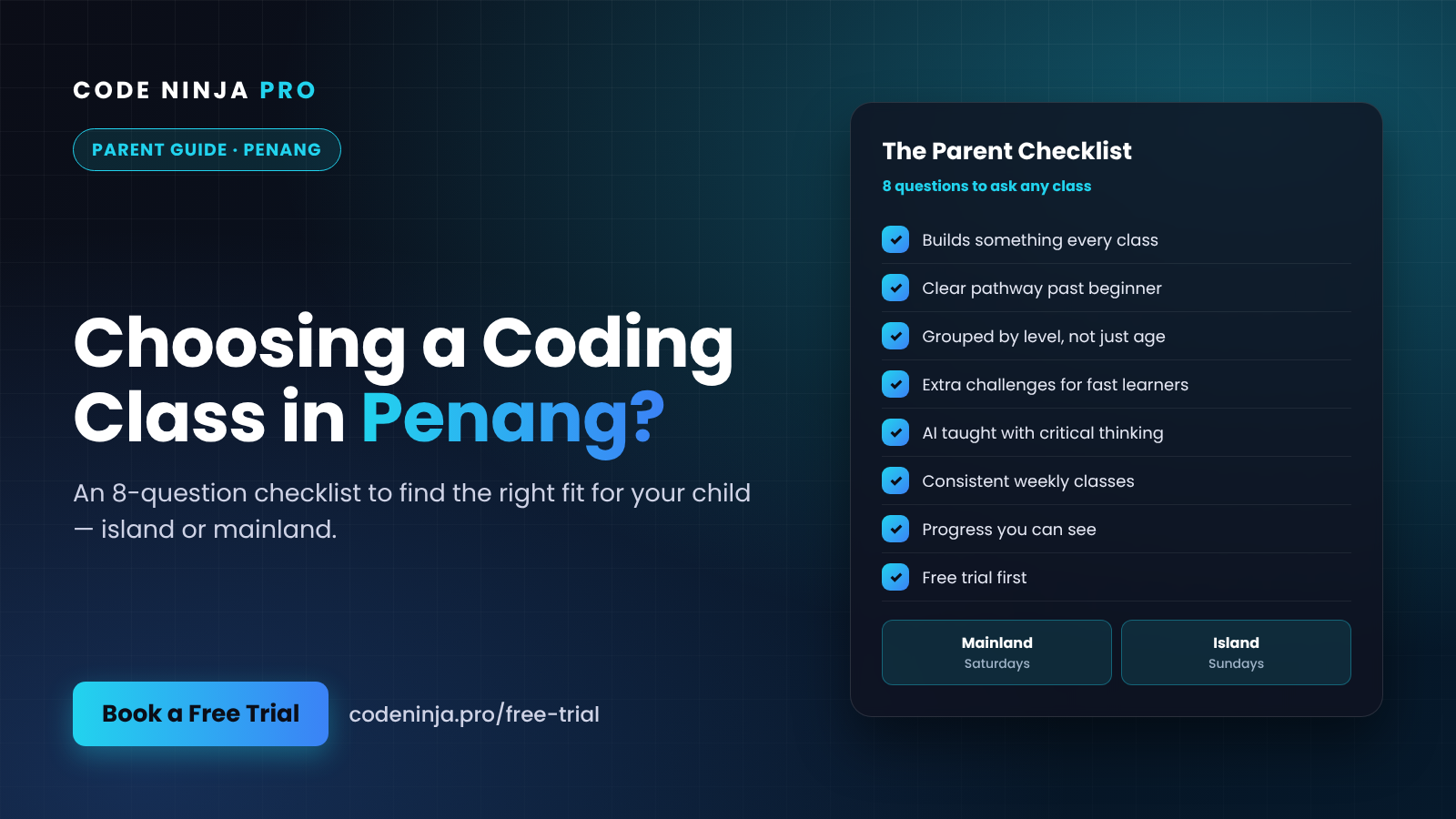
Our path follows the same foundations: Scratch for logic, Python for real code, then web, apps, AI and robotics. Classes run on Penang mainland (Saturdays) and island (Sundays).
Every free trial includes a hands-on build, so you can see how your child thinks, not just what they know.
Book a free trial 👉 codeninja.pro/free-trial
FAQ
What is the Penang STEM Talent Pilot? A programme launched by the federal Economy Ministry with the Penang government and industry on 10 August 2026. It has RM12.3 million over four years and aims to reach 100,000 students by 2030.
Does my child need to want an engineering career to benefit? No. Logical thinking, coding and problem-solving help in almost any future career, inside or outside tech.
Is coding really related to chip design? Yes. Chips are designed using specialised hardware description languages and software tools. The thinking habits are the same ones children build when they code.
My child prefers art and stories. Is STEM still for them? Absolutely. Many children first fall in love with coding by making animations and interactive stories in Scratch.
Where are your classes? Penang mainland on Saturdays and Penang island on Sundays. Book a free trial at codeninja.pro/free-trial.
Ready To Experience Coding First-Hand?
Join our FREE Trial Classes and discover the exciting world of coding, AI and robotics.