A New AI Model Every Week: What Should Your Child Actually Learn?
If you have scrolled through the news this month, you have probably noticed something: a new "smartest AI ever" seems to arrive every few days. In the first week of September 2026 alone, several of the world's biggest AI labs released new flagship models, each one promising to be faster, cleverer and more capable than the last.
For parents, this creates a very real worry. Which one should my child be learning? Will the app they use today be outdated by next year? Are we already behind?
Here is the good news: you do not need to chase every release. The specific tools will keep changing. The skills that make a child good at using, questioning and building with AI will not. This guide explains what those lasting skills are, how to spot whether your child is building them, and simple ways to support them at home.
Why Chasing the "Latest Model" Is the Wrong Goal
Think about how we learned to use computers. The children who did well were not the ones who memorised one version of one program. They were the ones who understood how computers think: files, folders, logic, and how to figure out a new app on their own.
AI is the same, only faster. The model your child uses today will almost certainly be replaced within months. If their learning is tied to one app's buttons and menus, it expires with that app. If it is tied to understanding, it carries forward to every new tool that comes after.
That is why at Code Ninja Pro we do not teach "how to use Tool X". We teach children how to think clearly with AI, check what it tells them, and build things of their own using it.
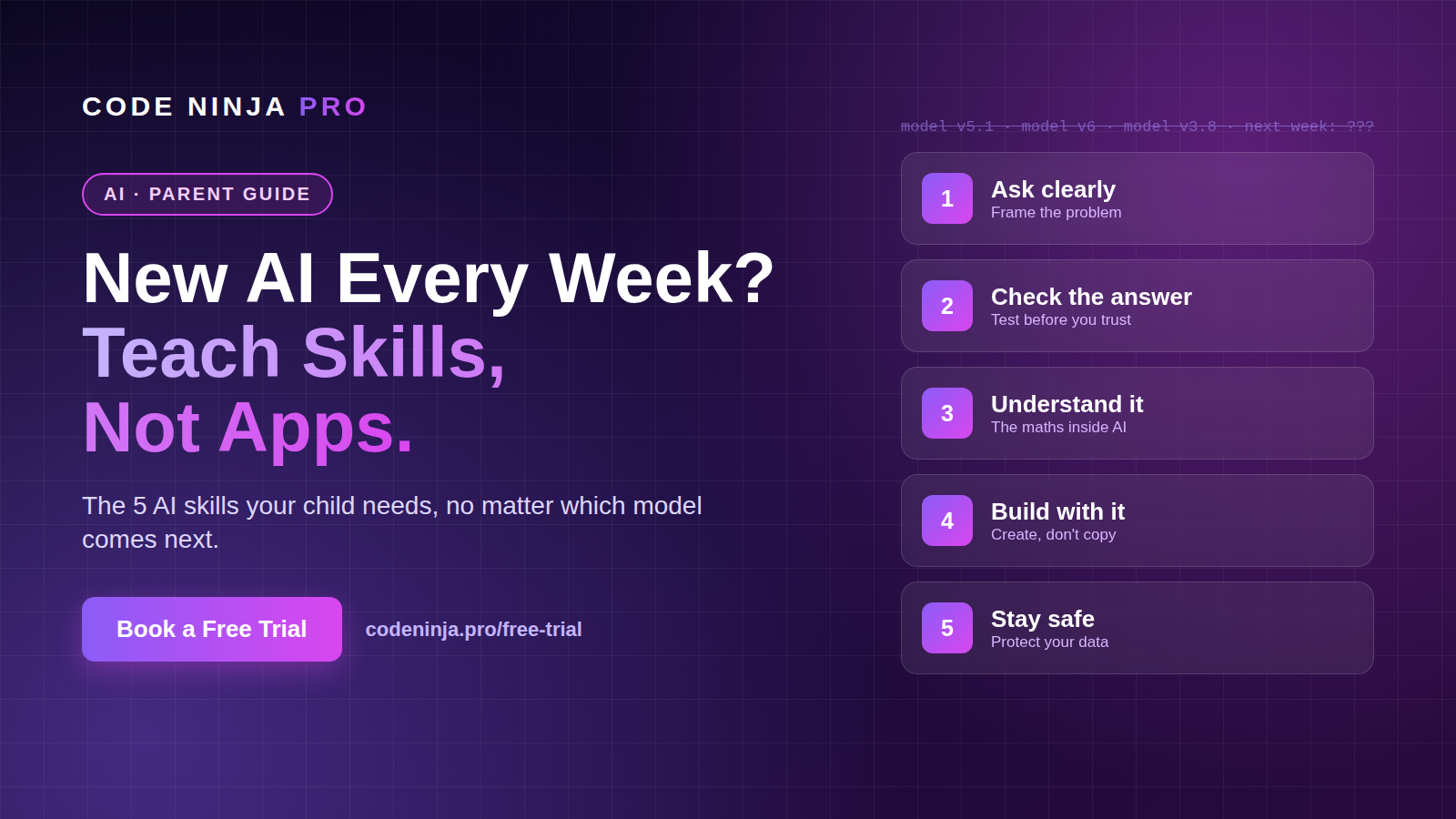
The 5 AI Skills That Outlast Any Model
1. Asking clearly (problem framing)
An AI can only help with the question it is given. Children who can break a problem into clear parts, explain what they want, and give useful context get far better results from any AI, and from teachers, classmates and search engines too.
This is really a thinking skill, not a technology skill. A child who can say "I need to compare these two things, for this reason, in this format" is showing the same structured thinking that helps in essays, science projects and maths problems.
2. Checking the answer (critical thinking)
AI tools can sound confident and still be wrong. They can make calculation mistakes, mix up facts, or give an answer that sounds right but does not fit the question.
The most valuable habit a young AI user can have is to ask: How do I know this is right? That might mean testing the answer, working through a step by hand, comparing it with a textbook, or simply asking "does this make sense?" In our classes, every feature a student builds goes through a test-and-verify step before it counts as done. That habit matters more than any single tool.
3. Understanding how it works (the maths inside)
Large language models, the technology behind today's AI chatbots, are not magic. At a simple level, they learn patterns from huge amounts of text and predict what is likely to come next. Ideas like probability, patterns, data and logic sit right underneath.
Children do not need university maths to grasp this. But when they understand roughly how AI works, two good things happen: they become less intimidated by it, and they become better at spotting when it is likely to make mistakes. This is also where AI connects naturally with the maths they already learn in school.
4. Building with AI, not just using it
There is a big difference between a child who asks a chatbot for answers and a child who builds a small app, game or helper tool that uses AI inside it.
Building teaches planning, coding, debugging and patience. It turns AI from something that does the work for them into something they direct. In our AI Creator Program, AI is integrated into every project students build, so they learn to treat it as a component they control rather than a shortcut.
5. Using AI safely and responsibly
Knowing what not to share (personal details, passwords, photos), understanding that AI output should be credited honestly in schoolwork, and recognising when to ask a trusted adult are all part of AI literacy. These habits are easiest to form young, before a child's use of AI becomes private and unsupervised.
Quick Checklist: Is Your Child Using AI to Learn, or to Skip Learning?
Use these five questions after your child uses an AI tool for schoolwork or a project. You do not need to be technical to ask them.
- Can they explain the answer in their own words? If not, the AI did the thinking, not your child.
- Did they check anything? Ask what they tested, compared or double-checked.
- Could they do the next similar problem without the AI? Good AI use should leave them more able, not less.
- Did they make something, or only receive something? Building, editing or improving shows real engagement.
- Did they share anything personal? A quick, calm check builds safe habits early.
If most answers are "yes", your child is already using AI in a healthy, learning-focused way. If not, that is completely normal. These are habits, and habits can be taught.
What This Means for Malaysian Families
AI literacy is becoming part of everyday learning, both in Malaysia and around the world. For most families, the question is no longer whether children will use AI, but how well they will use it.
The children who will be most comfortable with future technology are unlikely to be those who knew the most app names. They will be those who learned to think clearly, check carefully, understand the basics, and build confidently. Those foundations take time, and they are easier to build step by step from a young age than all at once later.
A structured path helps. At Code Ninja Pro, students progress from Scratch to Python, then to web and app development, and on to AI and robotics, so each new idea builds on the last. AI is not treated as a separate trick bolted on at the end, but as something woven into how students plan, create and test their work.
How to Support Your Child at Home This Week
You do not need to become an AI expert. Try one of these:
- Explore together. Sit with your child for ten minutes and ask an AI tool a question about a topic they love. Then ask: "Do we believe this? How could we check?"
- Ask "how did you get that?" Make it a normal dinner-table question for homework, whether or not AI was involved.
- Encourage making. A simple game, animation or story they created teaches more than a hundred answers they copied.
- Set a simple family rule. For example: "AI can explain, but you must do the final work yourself."
Ready to Give Your Child a Strong Start?
New AI models will keep arriving every month. Your child does not need to keep up with every one. They need the thinking skills to handle whatever comes next.
If you would like your child to learn coding and AI in a structured, hands-on way, with real projects and a focus on understanding rather than shortcuts, we would love to meet them.
Book a Free Trial Class and see how your child learns to think, build and create with technology.
Frequently Asked Questions
1. What age should my child start learning about AI? Children can start building the foundations, such as logical thinking, sequencing and simple coding, from around primary school age using visual tools like Scratch. More direct AI concepts and building with AI usually suit children who are comfortable with basic coding, often in upper primary or lower secondary. The right starting point depends on your child's interest and readiness more than an exact age.
2. Should my child learn one specific AI tool, like a popular chatbot? It is fine for them to use popular tools, but their learning should not depend on any one of them. AI tools change quickly. Skills like clear questioning, checking answers and building projects transfer to every new tool.
3. Will using AI make my child lazy or stop them from thinking? It can, if AI is used only to get answers. Used well, AI can help children explore ideas, get explanations and build more ambitious projects. The key is guidance: asking them to explain, check and create, rather than copy.
4. Does my child need to be good at maths to learn AI? No. Many children discover that AI makes maths more interesting because they see patterns and probability being used in something real. A curious attitude matters more than top marks when starting out.
5. How is learning AI at Code Ninja Pro different from just using AI apps at home? At home, children often use AI as a user. In our classes, students learn to be creators: they code projects, integrate AI into what they build, test and debug their work, and learn why AI behaves the way it does. Each course builds on the previous one, from Scratch through Python to AI and robotics.
Ready To Experience Coding First-Hand?
Join our FREE Trial Classes and discover the exciting world of coding, AI and robotics.